
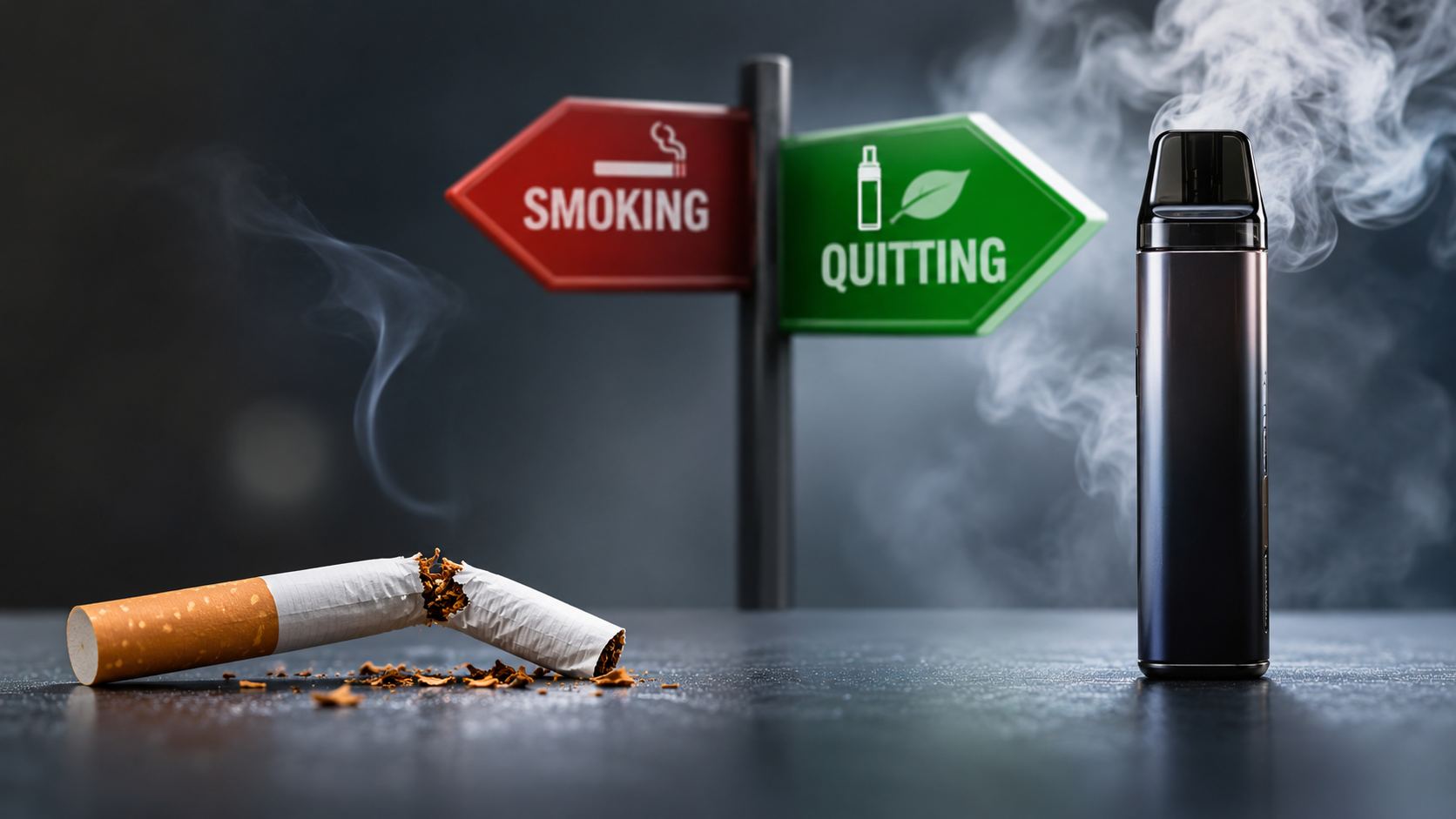
For years, smokers looking for alternatives to traditional cigarettes have encountered a growing number of discussions about electronic cigarettes, commonly known as vapes. One question continues to generate considerable interest among smokers, researchers and healthcare professionals: Can vaping actually help someone stop smoking?
The subject has attracted significant scientific attention, with researchers investigating whether nicotine-containing electronic cigarettes can help people stop using combustible tobacco products. Several clinical trials and systematic reviews have examined their effectiveness, while health organisations continue to evaluate their potential benefits, associated risks and long-term effects.
Interestingly, scientific evidence has evolved considerably over the past decade. More recent research has provided stronger evidence that nicotine-containing e-cigarettes can help some adults stop smoking cigarettes. However, this finding does not mean vaping is harmless, nor does it establish that every vaping product is suitable for smoking cessation.
To understand what the research actually tells us, it is important to examine the scientific findings, distinguish between smoking cessation and nicotine cessation, and consider the different positions taken by international health organisations.
Let's explore what the evidence says.
1. Understanding the Difference Between Smoking and Vaping
Before examining whether vaping can help someone stop smoking, it is important to understand how these two activities differ.
Traditional cigarettes work through combustion. When tobacco is burned, it produces smoke containing thousands of chemical substances, including carbon monoxide, tar and numerous toxic compounds associated with serious health conditions.
Electronic cigarettes operate differently. Instead of burning tobacco, they use a heating element to heat an e-liquid, producing an aerosol that the user inhales.
- Propylene glycol (PG).
- Vegetable glycerin (VG).
- Flavouring ingredients.
- Nicotine, where applicable.
The absence of tobacco combustion is an important distinction between the two products.
Cigarette smoke contains harmful substances generated through burning tobacco. E-cigarette aerosol has a different chemical composition, although it can still contain potentially harmful substances.
According to the UK National Health Service (NHS), e-cigarettes do not produce tar or carbon monoxide, two particularly harmful components of tobacco smoke.
However, this distinction should not be interpreted as evidence that vaping is completely safe. E-cigarette aerosol may contain nicotine, ultrafine particles, volatile organic compounds and certain metals.
The key difference is that vaping does not involve burning tobacco, but it still exposes users to substances that may affect their health.
2. What Does Scientific Research Say About Vaping and Smoking Cessation?
One of the most important developments in this area has been the growing body of clinical research investigating whether nicotine-containing e-cigarettes can help adult smokers stop using traditional cigarettes.
Researchers have examined different vaping devices, nicotine formulations, behavioural support programmes and conventional smoking cessation treatments.
Rather than relying on individual experiences or anecdotal reports, the strongest evidence comes from randomised controlled trials and systematic reviews.
A systematic review brings together findings from multiple studies to evaluate the consistency and reliability of the available evidence.
One of the most widely recognised organisations conducting this type of research is Cochrane.
The 2026 Cochrane Review: What Did Researchers Discover?
In August 2026, Cochrane published an updated review examining the effectiveness and safety of electronic cigarettes for smoking cessation.
The review evaluated 80 completed randomised controlled trials involving 29,861 participants.
Researchers compared nicotine-containing e-cigarettes with several alternatives, including:
- Traditional nicotine replacement therapies such as patches and gum.
- E-cigarettes without nicotine.
- Behavioural support.
- No additional smoking cessation support.
- Other smoking cessation interventions.
One of the most significant findings was that nicotine-containing e-cigarettes resulted in higher smoking cessation rates than traditional nicotine replacement therapy.
The researchers reported a relative risk of 1.61, with a 95% confidence interval of 1.23 to 2.12. This finding was supported by high-certainty evidence.
To understand what this means in practical terms, Cochrane estimated that approximately four additional people out of every 100 could stop smoking when using nicotine-containing e-cigarettes compared with nicotine replacement therapy.
This is an important finding because nicotine replacement therapy already includes established smoking cessation products such as nicotine patches and gum.
The review also found that nicotine-containing e-cigarettes probably resulted in higher quit rates than non-nicotine e-cigarettes.
However, the researchers highlighted that more evidence is needed to understand the potential adverse effects of vaping, particularly serious adverse events and longer-term health outcomes.
What does this research mean?
The findings provide substantial evidence that nicotine-containing e-cigarettes can help some adults stop smoking combustible cigarettes.
However, the research does not establish that vaping is harmless, nor does it mean that every commercial vaping device has been tested or proven effective as a smoking cessation treatment.
Research reference: Cochrane, Electronic Cigarettes for Smoking Cessation, 2026.
3. How Could Vaping Help Some Smokers Stop Smoking?
To understand why vaping may help certain smokers, researchers have examined the role of nicotine, cigarette cravings and the behavioural patterns associated with smoking.
There are several factors worth considering.
A. Nicotine Replacement Without Burning Tobacco
Nicotine is the primary addictive substance in tobacco cigarettes.
When someone who regularly smokes suddenly stops consuming nicotine, they may experience withdrawal symptoms.
These can include:
- Strong cigarette cravings.
- Irritability.
- Restlessness.
- Difficulty concentrating.
- Increased appetite.
- Changes in mood.
Nicotine-containing e-cigarettes can deliver nicotine without requiring the user to burn tobacco.
This may help some smokers manage nicotine cravings while moving away from combustible cigarettes.
However, nicotine remains addictive regardless of whether it comes from traditional cigarettes or an electronic delivery system.
B. Familiar Smoking-Related Behaviour
Smoking involves more than nicotine consumption.
For many smokers, it becomes associated with particular routines and activities.
Examples include:
- Holding a cigarette between the fingers.
- Bringing it to the mouth.
- Inhaling and exhaling.
- Smoking during work breaks.
- Smoking after meals.
- Smoking while socialising.
These behaviours can become deeply associated with daily routines.
Vaping reproduces some of these familiar actions, which may make the transition away from cigarettes more manageable for certain individuals.
Researchers have investigated the importance of these behavioural similarities in understanding why some smokers find e-cigarettes useful when attempting to quit.
C. Managing Cigarette Cravings
Another important consideration is how nicotine delivery affects cigarette cravings.
Different e-cigarette devices and nicotine formulations can deliver nicotine at different rates.
For some smokers, the ability to obtain nicotine through an alternative delivery system may help manage withdrawal symptoms while discontinuing combustible cigarettes.
Nevertheless, individual experiences vary considerably. The effectiveness of any smoking cessation approach can depend on nicotine dependence, smoking history, behavioural patterns and access to appropriate support.
4. Is Vaping Less Harmful Than Smoking Traditional Cigarettes?
This is one of the most frequently discussed questions surrounding electronic cigarettes.
To examine it properly, we need to distinguish between two different concepts:
- Whether a product is completely safe.
- Whether a product exposes users to fewer harmful substances than another product.
These are not the same question.
Traditional cigarettes produce smoke through tobacco combustion. This process releases numerous harmful chemicals, including carbon monoxide and other toxic substances.
E-cigarettes do not burn tobacco, so their aerosol generally contains fewer and lower levels of many harmful chemicals found in cigarette smoke.
What Did the National Academies Discover?
In 2018, the US National Academies of Sciences, Engineering, and Medicine published an extensive report titled Public Health Consequences of E-Cigarettes.
The report examined available scientific evidence concerning the health effects of electronic cigarettes.
Among its conclusions was that completely substituting e-cigarettes for combustible tobacco cigarettes reduces exposure to numerous toxicants and carcinogens found in cigarette smoke.
The report also identified evidence of reduced short-term adverse health outcomes in several areas following a complete switch.
However, researchers emphasised that e-cigarette aerosol can still contain potentially harmful substances.
These include:
- Nicotine.
- Certain volatile organic compounds.
- Ultrafine particles.
- Metals that may originate from device components.
- Other chemicals produced during aerosol formation.
The composition of the aerosol can vary depending on the device, heating conditions, e-liquid formulation and other factors.
Does Reduced Exposure Mean Vaping Is Safe?
No.
A reduction in exposure to certain harmful chemicals does not automatically mean that a product is harmless.
Vaping still carries potential health risks and scientists continue to investigate its long-term effects.
The distinction is particularly important when comparing complete switching with continued cigarette smoking.
For an adult who already smokes, completely replacing combustible cigarettes with e-cigarettes may reduce exposure to many harmful substances associated with tobacco combustion.
However, someone who does not smoke has no health-related reason to begin vaping.
Research reference: National Academies of Sciences, Engineering and Medicine, Public Health Consequences of E-Cigarettes, 2018.
5. Complete Switching vs Dual Use: Why Does It Matter?
An important issue in smoking cessation research is the difference between completely replacing cigarettes with e-cigarettes and using both products simultaneously.
These situations are often confused, but they represent different patterns of nicotine and tobacco consumption.
Complete Switching
Complete switching occurs when someone stops smoking combustible cigarettes and uses an alternative nicotine delivery product instead.
This distinction matters because it removes exposure associated with burning tobacco.
Research from the National Academies indicates that completely substituting e-cigarettes for combustible cigarettes reduces exposure to numerous toxicants found in cigarette smoke.
Dual Use
Dual use describes a situation where someone continues smoking traditional cigarettes while also using electronic cigarettes.
For example, someone might smoke cigarettes during the day but use a vape when smoking is inconvenient or restricted.
This does not represent complete smoking cessation.
The US Centers for Disease Control and Prevention (CDC) warns that dual use is not an effective way to safeguard health.
Even smoking a relatively small number of cigarettes can expose someone to harmful substances.
Consequently, using both products should not be presented as equivalent to completely stopping cigarette smoking.
Complete Nicotine Cessation
The most comprehensive outcome is stopping both combustible cigarettes and vaping products.
This eliminates exposure from these products and avoids continued nicotine dependence where nicotine was being consumed.
Understanding these three situations is essential when interpreting research about vaping and smoking cessation.
6. What Do WHO, NHS and CDC Say About Vaping and Smoking Cessation?
Although scientific studies have demonstrated that nicotine-containing e-cigarettes can help some adults stop smoking, international health organisations have not adopted identical positions.
Understanding these differences provides a more complete picture of the subject.
World Health Organization (WHO)
The World Health Organization maintains a cautious position on electronic cigarettes.
Its concerns include:
- Nicotine addiction.
- Potential cardiovascular and respiratory effects.
- Exposure to harmful substances in e-cigarette aerosol.
- Long-term health uncertainties.
- Continued nicotine dependence.
An important distinction is that the WHO considers not only whether vaping may help an individual smoker quit but also its broader implications for public health.
These include the possibility of non-smokers beginning nicotine consumption and developing nicotine dependence.
Its position therefore considers a wider range of issues than the effectiveness of e-cigarettes in individual smoking cessation trials.
United Kingdom National Health Service (NHS)
The NHS recognises nicotine-containing e-cigarettes as a potential smoking cessation option for adults who smoke.
It acknowledges that vaping can help manage nicotine cravings and that research has demonstrated its effectiveness in helping some smokers stop using traditional cigarettes.
However, the NHS also emphasises that people need to stop smoking cigarettes completely to obtain the potential benefits of switching.
It recommends combining appropriate smoking cessation support with a suitable plan for quitting cigarettes.
The NHS does not recommend vaping for people who have never smoked.
United States Centers for Disease Control and Prevention (CDC)
The CDC acknowledges that nicotine-containing e-cigarettes may have potential benefits for adults who smoke and are not pregnant, provided they completely replace smoked tobacco products.
However, it makes several important qualifications:
- No e-cigarette has been approved by the US Food and Drug Administration (FDA) as a smoking cessation aid.
- The long-term health effects of vaping remain uncertain.
- E-cigarettes are not harmless.
- Non-smokers should not start vaping.
- Dual use does not provide the same potential benefits as completely switching away from cigarettes.
The CDC also recognises established smoking cessation approaches, including approved medications and behavioural counselling.
Why Do These Organisations Have Different Positions?
At first glance, the positions of Cochrane, WHO, NHS and CDC may appear contradictory.
However, they are often examining different aspects of the same issue.
Cochrane evaluates clinical evidence to establish whether e-cigarettes help individual smokers stop smoking.
The WHO considers broader population-level implications, including youth uptake, nicotine dependence and the regulation of nicotine products.
The NHS recognises the potential of e-cigarettes within its smoking cessation approach, while the CDC acknowledges possible benefits but highlights regulatory and long-term safety uncertainties.
These positions demonstrate why it is important to consider both clinical research and public health guidance when discussing vaping.
7. Can You Become Addicted to Vaping After Quitting Cigarettes?
Yes.
One of the most important distinctions in this discussion is the difference between stopping cigarette smoking and overcoming nicotine dependence.
These are two separate outcomes.
Someone may successfully stop smoking traditional cigarettes but continue consuming nicotine through electronic cigarettes.
For example, an individual who previously smoked combustible cigarettes might switch completely to a nicotine-containing e-cigarette.
Although that person has stopped smoking cigarettes, they may still depend on nicotine.
Smoking Cessation vs Nicotine Cessation
Smoking cessation means stopping the consumption of combustible tobacco cigarettes.
Nicotine cessation means stopping nicotine consumption altogether, regardless of the delivery method.
A person can achieve the first without immediately achieving the second.
This is why smoking cessation studies also examine whether participants continue using e-cigarettes after they have stopped smoking.
Nicotine dependence can persist because nicotine affects the brain's reward system and can reinforce repeated consumption.
For people who eventually want to stop using nicotine altogether, professional guidance and appropriate cessation support may help them develop a suitable plan.
8. What Are the Potential Long-Term Health Risks of Vaping?
Although researchers have made considerable progress in understanding electronic cigarettes, important questions about their long-term health effects remain.
Traditional cigarette smoking has been studied extensively over many decades.
Electronic cigarettes are comparatively newer products, meaning researchers have less long-term population data available.
Several areas continue to receive scientific attention.
Respiratory Health
Inhaling e-cigarette aerosol exposes the respiratory system to substances that would not normally be present in clean air.
Researchers continue investigating the potential effects of repeated exposure on lung function, airway inflammation and respiratory health.
Cardiovascular Health
Nicotine can increase heart rate and blood pressure.
Researchers are also examining how other aerosol constituents may influence cardiovascular function.
The full implications of long-term vaping for cardiovascular health are not yet established.
Chemical Exposure
The chemicals present in e-cigarette aerosol depend on several factors, including:
- E-liquid ingredients.
- Heating temperature.
- Device construction.
- Coil condition.
- Usage patterns.
Nicotine Dependence
Nicotine remains an addictive substance.
Continued consumption can maintain dependence even after someone has stopped smoking cigarettes.
These uncertainties reinforce why vaping should not be described as harmless or risk-free.
9. What Does This Research Mean for Smokers in Kenya?
The discussion surrounding vaping and smoking cessation is relevant to Kenya, where tobacco control and access to smoking cessation support remain important public health priorities.
Kenya has an established tobacco control framework and continues working to strengthen its approach to tobacco dependence treatment.
In June 2026, the World Health Organization reported that Kenya had undertaken a process to revise its National Tobacco Cessation Guidelines with technical support from WHO.
The revision process focused on four major intervention categories:
- Brief advice from healthcare professionals.
- Intensive behavioural counselling.
- Digital cessation support.
- Pharmacological treatments.
These approaches recognise that quitting tobacco can require more than individual determination.
Nicotine dependence can be difficult to overcome, and people attempting to stop smoking may benefit from professional guidance and structured support.
Where Does Vaping Fit Into the Kenyan Context?
International clinical research suggests that nicotine-containing e-cigarettes can help some adult smokers stop smoking combustible cigarettes.
However, this evidence should not automatically be interpreted as an official Kenyan recommendation to use commercial vaping products as smoking cessation treatments.
The evidence also needs to be interpreted carefully.
Many clinical trials examine specific nicotine-containing e-cigarettes under defined study conditions. Their findings should not automatically be generalised to every disposable vape, recreational shisha vape or other commercial vaping device available in the market.
For Kenyan smokers considering quitting, healthcare professionals can provide information about established cessation approaches, including behavioural support and appropriate medical treatments.
The broader objective should always be to stop smoking and, where possible, eventually overcome nicotine dependence.
10. Frequently Asked Questions About Vaping and Smoking Cessation
Can vaping actually help someone stop smoking cigarettes?
Scientific research suggests that nicotine-containing e-cigarettes can help some adults stop smoking combustible cigarettes. A 2026 Cochrane review involving 80 trials and 29,861 participants found higher smoking cessation rates with nicotine e-cigarettes than with traditional nicotine replacement therapy.
However, effectiveness varies, and vaping is not a risk-free solution.
Is vaping safer than smoking traditional cigarettes?
Completely switching from combustible cigarettes to e-cigarettes reduces exposure to many harmful chemicals produced by burning tobacco. However, vaping still exposes users to potentially harmful substances and its long-term health effects remain under investigation.
Does vaping eliminate nicotine addiction?
No. Most nicotine-containing e-cigarettes deliver nicotine, which is addictive. Someone can stop smoking cigarettes but continue to depend on nicotine through vaping.
Can someone use both cigarettes and vapes?
Some people engage in dual use, meaning they consume both products. However, this should not be considered equivalent to quitting smoking. Continued cigarette consumption maintains exposure to harmful substances produced by tobacco combustion.
Are nicotine-free vapes effective for smoking cessation?
Research has also investigated e-cigarettes without nicotine. However, the 2026 Cochrane review found that nicotine-containing e-cigarettes probably produce higher smoking cessation rates than non-nicotine alternatives.
Nicotine-free products are not automatically risk-free, either.
Are e-cigarettes officially approved smoking cessation medications?
This depends on the country and its regulatory framework. In the United States, the FDA has not approved any e-cigarette as a smoking cessation medication.
Clinical evidence demonstrating potential effectiveness should not be confused with formal regulatory approval.
Should non-smokers start vaping?
No. People who do not smoke or consume nicotine should not start vaping. There is no health benefit in introducing nicotine dependence when someone does not already use tobacco or nicotine products.
Is quitting smoking the same as quitting nicotine?
No. Quitting smoking means stopping combustible cigarettes, while quitting nicotine means stopping nicotine consumption altogether. Someone can achieve smoking cessation while continuing to use nicotine-containing products.