
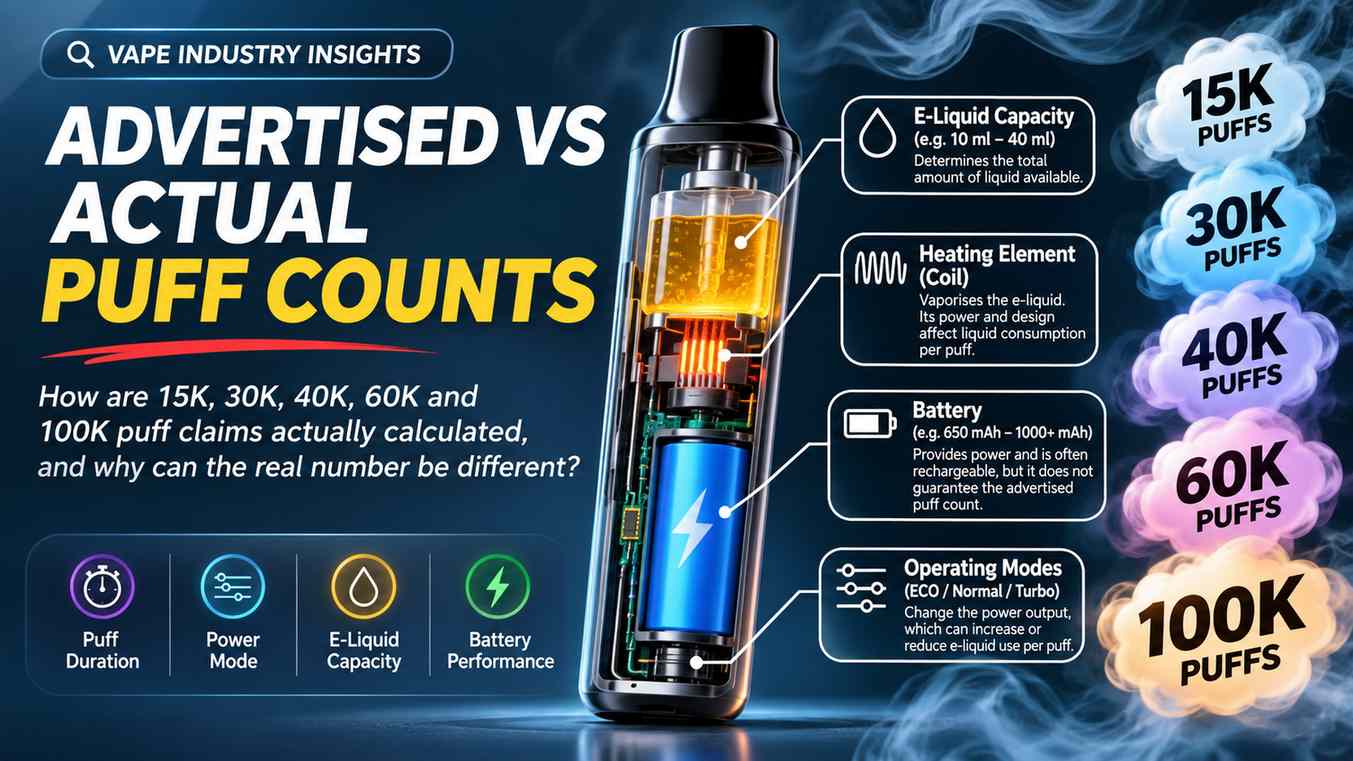
The numbers printed on modern vape devices have become increasingly ambitious. Products advertised as 15,000, 30,000, 40,000, 60,000 and even 100,000 puffs are now part of the international vape market.
But what does a 40,000-puff or 100,000-puff claim actually represent? Is it a laboratory-tested measurement, a manufacturer's theoretical estimate or a figure calculated under specific operating conditions?
Key Factors That Determine a Vape's Actual Puff Count
Understanding these numbers requires looking beyond the packaging. The following are key determinants of how many puffs a device will yield by the time the e-liquid is used up;
- Puff duration
- Airflow
- E-liquid capacity
- Heating technology
- Battery performance
- Device operating modes All influence how many activations a device can produce before its usable resources are exhausted.
Research and industry investigations have also raised questions about the relationship between advertised puff counts and observed device performance. This makes it important to understand how manufacturers arrive at these figures and why the actual number of puffs can differ between testing conditions and individual users.
This article examines the technical principles behind puff-count calculations, the limitations of advertised figures and what the numbers on high-capacity vape devices actually tell us.
1. What Does a Vape Puff Count Represent?
A puff count is a numerical estimate of how many individual activations or draws a vape device is expected to produce under specified operating conditions.
For example:
- 15K represents an advertised 15,000 puffs.
- 30K represents an advertised 30,000 puffs.
- 40K represents an advertised 40,000 puffs.
- 60K represents an advertised 60,000 puffs.
- 100K represents an advertised 100,000 puffs.
These figures are generally manufacturer specifications rather than guaranteed results for every individual user.
A device advertised as providing 40,000 puffs does not necessarily deliver exactly 40,000 puffs under every usage pattern.
The distinction is important because a puff is not a universally fixed quantity of aerosol. A short draw and a longer draw can activate the same device for different periods, consuming different amounts of e-liquid.
Consequently, the advertised number alone does not establish how long a device will operate under real-world conditions.
2. How Do Manufacturers Calculate Advertised Puff Counts?
Puff-count calculations generally involve estimating how many individual activations a device can produce from its available e-liquid and power resources.
The amount of e-liquid consumed during each activation is particularly important.
A simplified theoretical relationship is:
Estimated puff count = Usable e-liquid quantity ÷ Average e-liquid consumption per puff
However, this is not a universal manufacturer calculation formula. Actual calculations may incorporate laboratory measurements, device-specific operating conditions and engineering estimates.
Consider a hypothetical device containing 20ml of usable e-liquid.
If its average consumption under a particular test condition were 0.001ml per puff, the theoretical result would be:
20ml ÷ 0.001ml = 20,000 puffs.
If the consumption per activation were different, the resulting estimate would also change.
This illustrates why e-liquid capacity alone cannot establish an exact puff count.
Other factors include:
- Heating element power.
- Coil resistance and configuration.
- Airflow characteristics.
- Puff duration.
- Device operating mode.
- E-liquid formulation.
- Available battery energy.
- Device performance throughout its operating life.
Without knowing the conditions used to calculate the advertised figure, it is difficult to make a meaningful comparison between two devices based solely on their puff-count labels.
3. Why Puff Duration Changes the Actual Number of Puffs
Puff duration is one of the most important variables affecting aerosol generation.
A short activation generally requires less heating time than a longer activation. As heating time increases, the device can generate more aerosol and consume more e-liquid, provided its wick remains adequately supplied.
This means that two people using the same device can obtain different total puff counts.
For example, consider two hypothetical usage patterns:
Shorter activations
A person takes relatively brief draws, resulting in less heating time per activation.
Longer activations
Another person takes longer draws, keeping the heating element active for a greater period.
Although both users operate the same device, their average e-liquid consumption per puff may differ.
Research published in the scientific literature has documented considerable variation in vaping behaviour, including puff duration, volume and intervals between puffs.
One study examining electronic cigarette users reported an average puff duration of approximately 2.65 seconds, while another study found an average duration of approximately 2.8 seconds, with substantial variation between participants.
These findings demonstrate why a manufacturer's estimated puff count should not automatically be interpreted as an identical real-world result for every user.
4. Laboratory Puff Testing: Is There a Standard Measurement?
There are established technical standards for generating e-cigarette aerosol under controlled laboratory conditions.
One important reference is ISO 20768:2018, developed for routine analytical vaping machines.
The associated CORESTA Recommended Method No. 81 specifies a controlled puffing regime involving:
Testing parameter | Standard condition |
|---|---|
Puff duration | 3 seconds |
Puff volume | 55ml |
Puff frequency | One puff every 30 seconds |
Flow profile | Approximately rectangular |
These conditions help laboratories generate reproducible aerosol samples for analytical testing.
However, there is an important distinction: ISO 20768 is not a universal certification standard for the advertised lifetime puff count printed on disposable vape packaging.
It specifies conditions for routine analytical vaping and aerosol generation, not a guarantee that every device will produce a particular total number of puffs.
Different testing conditions can produce different results. The duration of each activation, intervals between activations and device configuration all influence aerosol generation.
CORESTA's Guide No. 22, which addresses more intensive vaping regimes, also discusses how these variables affect aerosol delivery.
This is why any meaningful puff-count verification should disclose the device tested, operating mode, puff duration, testing conditions and stopping criteria.
5. How ECO, Normal and Turbo Modes Affect Puff Counts
Some modern devices feature selectable operating modes that alter their power output or aerosol-generation characteristics.
Common labels include ECO, Normal, Smooth and Turbo.
Although the exact implementation differs between manufacturers, these settings can influence the amount of energy delivered to the heating element.
ECO Mode
ECO settings generally prioritise lower power consumption or reduced output, depending on the device design.
Lower output may reduce e-liquid consumption per activation under comparable conditions.
Normal Mode
Normal mode typically represents the manufacturer's standard operating configuration.
Its power delivery and aerosol output depend on the particular device.
Turbo Mode
Turbo settings generally increase output or heating intensity where supported by the device.
Higher output can increase aerosol production and e-liquid consumption per activation. Consequently, the total number of activations obtainable from a fixed quantity of e-liquid may decrease.
This relationship is not identical across every device because manufacturers implement their operating modes differently.
A product advertised with a maximum puff count should therefore be evaluated alongside the mode and testing conditions associated with that claim.
6. E-Liquid Capacity and Its Relationship With Advertised Puff Counts
E-liquid capacity provides another useful reference when examining high-puff devices.
The amount of liquid available places a physical constraint on how much aerosol a device can generate over its operating life.
A device containing 10ml of usable e-liquid does not have the same liquid capacity as one containing 20ml or 40ml.
However, twice the e-liquid does not automatically mean twice the number of puffs.
The relationship depends on how much liquid the device consumes during each activation.
For example, two devices may have identical liquid capacities but different heating configurations, power outputs and airflow characteristics.
Their estimated puff counts could therefore differ.
When evaluating advertised puff figures, it is useful to distinguish between:
- Total stated e-liquid capacity.
- Actual usable liquid capacity.
- Individual reservoir or pod capacity.
- Additional refill capacity.
- Liquid consumption under the stated operating conditions.
This distinction becomes particularly important with devices featuring replaceable pods, refill containers or multiple liquid reservoirs.
An advertised total may refer to the combined capacity across multiple refills rather than the liquid available in the device at one time.
7. Why a Rechargeable Battery Does Not Guarantee the Advertised Puff Count
They allow a device to receive additional electrical energy after its initial battery charge has been depleted.
However, battery capacity and puff count represent two different specifications.
Battery capacity, generally expressed in milliampere-hours (mAh), describes the rated electrical charge capacity of a battery.
It does not directly establish how many puffs a device can produce.
Several factors influence the relationship between battery performance and device operation:
Power Consumption: Higher output settings generally require more electrical energy.
Battery Capacity: Devices with different battery capacities have different available electrical energy reserves.
Charging Cycles: Rechargeability allows the battery to be replenished, but it does not replenish consumed e-liquid.
Heating Element Performance: Coil condition and electrical characteristics can change during the device's operating life.
Device Electronics: Circuitry, displays and other electronic components also consume power.
A rechargeable device may therefore have sufficient battery capacity for extended operation while still reaching the end of its usable e-liquid supply.
The reverse is also possible: available e-liquid may remain while the battery, heating element or another component can no longer support normal operation.
A battery specification should consequently never be treated as independent proof of an advertised puff total.
8. Are 10K,15K, 30K, 40K, 60K, 100K Puff and More Claims Independently Verified?
This is where the discussion becomes particularly important.
Advertised puff counts are manufacturer claims. Their presence on packaging does not, by itself, establish that an independent laboratory has verified the complete number under a disclosed testing protocol.
An investigation published by eCig One in February 2026 examined advertised puff counts and e-liquid capacities across 460 disposable vape models.
Its analysis reported an average manufacturer-claimed figure of approximately 1,146 puffs per millilitre across its dataset.
Importantly, this was an analysis of advertised specifications, not an independent laboratory test demonstrating that every device delivered its stated number of puffs.
Another investigation published by 2FIRSTS in April 2024 examined a disposable vape advertised at 15,000 puffs.
The publication reported obtaining approximately 3,000 puffs during its own test involving a human participant.
That result is an example of a discrepancy observed under a particular test, not proof that every 15,000-puff device will produce the same result.
More recently, VapeRisk Labs published a claimed-versus-measured evidence database covering device specifications, physical teardowns and selected component measurements.
Its dataset explicitly distinguishes manufacturer claims, component markings, observations, bench measurements and estimates. It also states that none of the advertised puff totals in its comparison dataset had been verified through a standardized puff-count test.
These investigations highlight an important issue: advertised specifications and independently measured performance are not interchangeable.
9. What Do 15K, 60K and 100K Puff Labels Actually Tell You?
Large puff-count labels communicate a manufacturer's estimated device capacity under its chosen conditions.
However, they should not be interpreted as guaranteed real-world totals.
Here is how to understand the terminology:
Advertised label | What the figure represents |
|---|---|
15K Puffs | Manufacturer-advertised estimate of 15,000 activations |
30K Puffs | Manufacturer-advertised estimate of 30,000 activations |
40K Puffs | Manufacturer-advertised estimate of 40,000 activations |
60K Puffs | Manufacturer-advertised estimate of 60,000 activations |
100K Puffs | Manufacturer-advertised estimate of 100,000 activations |
The figures are not directly comparable unless the devices have been evaluated under equivalent conditions.
For a meaningful technical comparison, the following information matters:
- Total usable e-liquid capacity.
- Battery specifications and rechargeability.
- Heating element configuration.
- Available operating modes.
- Puff duration used during testing.
- Whether the advertised figure has independent verification.
- Whether the total includes multiple reservoirs or replacement pods.
Without this information, a larger number on the packaging does not necessarily establish proportionally greater real-world performance.
10. What Should Kenyan Consumers Understand About Advertised Puff Counts?
The Kenyan vape retail market includes devices carrying different advertised capacities, ranging from smaller disposable models to products claiming tens of thousands of puffs.
Understanding the distinction between manufacturer specifications and independently verified results is important when interpreting these labels.
A few principles are particularly relevant:
Advertised Figures Are Not Guaranteed Results
A 40,000-puff or 100,000-puff label should be understood as a manufacturer claim unless independently verified under a clearly disclosed protocol.
Usage Conditions Matter
Puff duration, output settings and device configuration can influence actual performance.
E-Liquid Capacity Provides Additional Context
Liquid capacity helps establish the amount of material available for aerosol generation, although it cannot independently determine the final puff count.
Rechargeability Is a Separate Specification
A rechargeable battery does not guarantee that a device will achieve its advertised puff total.
Testing Transparency Matters
A credible performance claim should identify the testing methodology, operating conditions and limitations of the result.
Ultimately, the advertised puff count is only one specification among several that determine how a device performs.